This page describes the first mentorship batch (March–May 2022). New batches are announced on the Bangla site and social channels.
32-hour (3-month) mentorship for non-programmers
A few decades ago every billion-dollar company was energy: British Petroleum, General Electric, Shell — oil ran the world. Now data runs the world. Whoever has the most data steers the planet. Google, Facebook, Amazon, Alibaba and Netflix sprint ahead on insight — even through COVID. Data did not run short while other businesses struggled.
Back to Bangladesh: many companies’ management talk to me about data analysis. Our market is forming — slowly. Everyone wants knowledge from data.
95 mentees, Google Meet + Slack app
“Everyone” means non-programmers (CSE and non-CSE). One or two batches around the 25th; the first batch was 95 seats, targeting ~50 certifications in four months.
My experience: women often lead in pattern analysis. Data worldwide shows women excelling as data analysts; my wife has been in banking 20 years — women understand the story inside data.
Training for this era, for a data-driven society
Recipes tell you nothing. Learning techniques is the key.
— Tom Colicchio
I have faced 75+ trainings professionally and researched online LMS platforms for a decade. This moment is genuinely maddening.
Most work ahead is data. Google talks of 6–12 month certifications replacing four-year data degrees for the new century; Google Trends shows a pandemic-shaped gap in people who understand data and decide with it.
Auditing the courses below at full scale showed how much Google, Microsoft and IBM invested to close that knowledge gap — truly impressive coursework. Crucially, no special institutional background is needed to start. Neighbors — India, the Philippines, Eastern Europe — have young people with skills we do not. Our problem is not talent; it is the absence of a strong data community. Many never learn how many gems are online; some drift into TikTok and Facebook boredom instead.
| Course | Link |
|---|---|
| Google Data Analytics Professional Certificate | Google Data Analytics Professional Certificate |
| IBM Data Analyst Professional Certificate | IBM Data Analyst Professional Certificate |
| Microsoft Certified: Data Analyst Associate | Microsoft Certified: Data Analyst Associate |
So what did I do? I built a Bangla data-analyst mentorship for non-programmers from that coursework plus my experience, focused on the Google certificate. A real analytics course takes 6–8 months at 15–20 hours a week; I compressed it to 3 months when I am in the driver’s seat. A webinar on the idea:
In a world deluged by irrelevant information, clarity is power. Today having power means knowing what to ignore.
— Yuval Noah Harari
In this overload age, the big job is priority — you cannot swallow everything; filter and balance. Without relevant skills the market calls you obsolete; the keyword today is staying relevant. This mentorship is about what to keep and what to drop.
Great things happened in those two years: real movement on the Google certificate in Bangladesh. I wanted many to start alone; they did — then asked for help mid-way. Same with my own children: memorizing to pass exams was never the goal.
Passing for the certificate is easy; real understanding needs outside help. Google uses clever links and keywords inside the course; without context they are hard. The coursework is excellent — it just needs a little more around it.
You can do the Google certificate alone. This mentorship adds global perspective and hand-holding into this line of work.
My story: global certification
My first global certification was 1999. Before exam centers existed in Bangladesh, some traveled to Singapore or India; others waited. I did not wait — I mock-tested on my own and finally sat eight exams in 1999, saving money from my job, everything already downloaded in my head.
Looking back: not for a job — for validation. Where do I stand on a global scale? That confidence in 1999 gave me something nothing else could. I understood how foreign jobs push you to stay home with a bigger calling; touching people’s lives beat a cubicle abroad. That insight took me into national data-driven institutions; I never looked back.
Many of the new generation want that validation too. Learning only for a job never lasts. Skill for work you love beside your current job is not wrong. Sky is the limit.
My pain is elsewhere: we spend 5–10 lakh taka on a university degree (with no placement duty) but resist paying for skills — so skills fall on our own lives; after the degree, market mismatch brings frustration.
What is the way out? What if a mentor appeared on that unknown road?
What does “exclusive” mentorship mean?
Everyone is different. Understanding needs separately makes delivery easy. I try to know you specifically, guide the whole class accordingly, and after analytics show you the crossroads of becoming a data scientist — the final destination!
Cadet college form master
In class seven I joined cadet college; our form (section) had 25 cadets and one dedicated form master. He owned everything for those 25 — covering chemistry excuses even though he taught geometry; proxying parents’ day; sitting by the hospital when we were sick. Meeting him later, eyes full of affection. That is mentorship ‘for life’.
Military academy platoon commander
A platoon commander of ~20 cadets over three years sees everything from dawn mile runs to diary checks before lights-out — committed involvement turning civilians into officers. Also mentorship ‘for life’.
Google Data Analytics Certification: backstory
Writing 5+ data-science books made me ask: what is the easy way for non-programmers to understand data? I built an exclusive analytics book and nearly a hundred videos. Working with those free materials showed that specialized material loses applications when run freemium — that started a different train of thought.
I have been a Coursera user for years. A year before writing the analytics book, a Google alert brought the certificate. From that perspective I designed a four-month analytics mentorship: ground-up, how a student learns to take insight from data — because why should this specialty stay limited to a few thousand people worldwide? I began hands-on with the analysis stage to smooth the pipeline.
I teach my way, but a global certification curriculum done properly lets a student earn an international certificate beside the teaching. Whether it lands a US job is secondary; self-validation at global level is the point.
Why 3 months instead of 6–8?
Everyone is busy; learning is yours, from your interest. My job is to bring you to a crossroads and create interest — the mentorship does the rest.
Watch the curriculum and resources here.
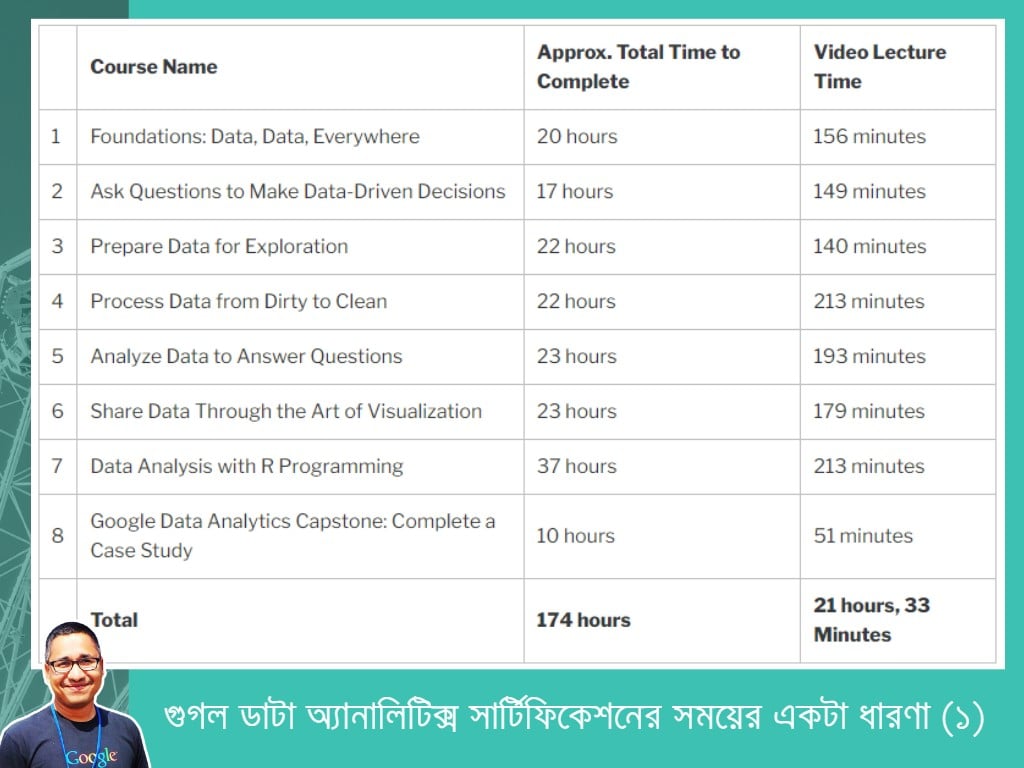
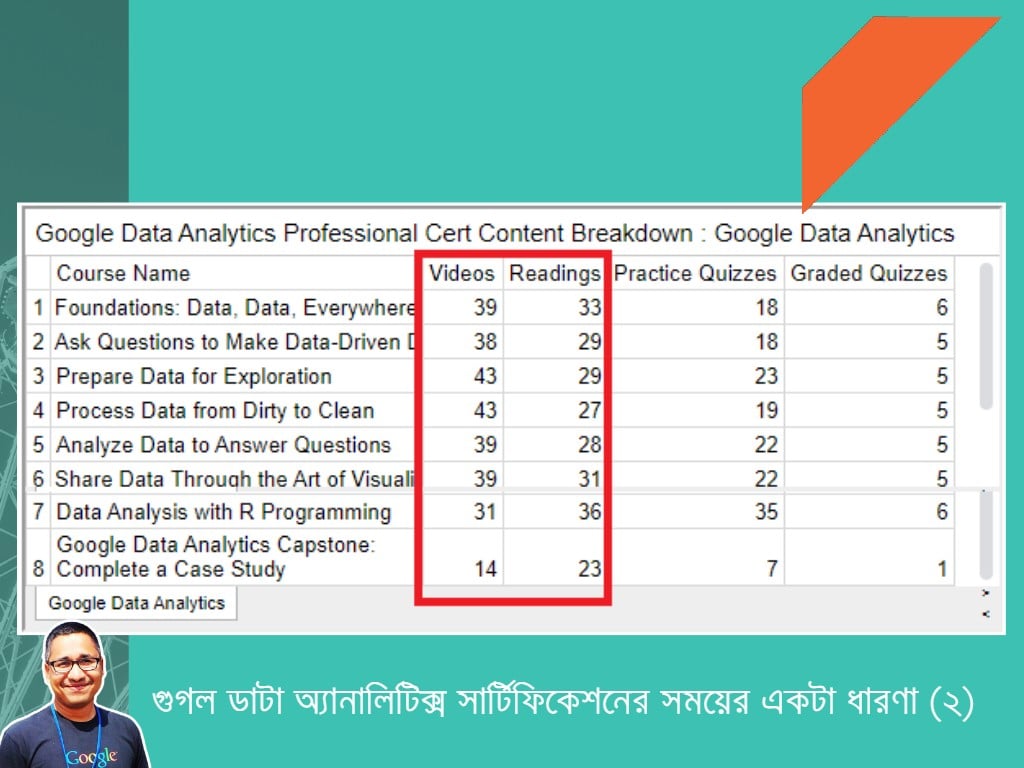
My research: the Google certificate typically takes ~174 hours. See the two figures below. It can be compressed, but the aid-application process makes under three months hard.
Eight separate courses (one capstone) average ~20 hours each — for real learning, not just the certificate. Google’s own videos total ~21 hours (~175 minutes per course, must-watch).
I have to download all of it into your brain in 32 hours. I will not help you cheat practice or graded quizzes; I will push you the whole time. Without serious commitment, certification is hard. I want serious learners ready for a future. No data background needed if the attitude is right.
Critical thinking and our mindset
The essence of the independent mind lies not in what it thinks, but in how it thinks.
— Christopher Hitchens
Analyst skills: relations among objects, finding patterns, finding questions inside data. Everyone has these regardless of education — my job is to sharpen them so you see problems through analyst eyes. Goal: 500 data analysts in one year.
Why is industry teaching analytics?
Whether we like it or not, industry skillsets are replacing the old degree. The trillion-dollar education industry vs the industry that hires started long ago. If industry interns a graduate into the system, why would it not teach directly? Why do Google and IBM build curricula? Why does Infosys run an academy?
If Google/IBM/Infosys build products, why teach a ten-year-old curriculum? They want what helps next year. Industry knows what it needs in this knowledge economy.
From that perspective, Google + Coursera brought a strong entry-level analytics course; Google and 150+ US companies talk placement. Not a job promise from me — this course is the first crossroads of any data-science roadmap; getting on that road matters.
I walked my two children (9th grade and college) through starting the certificate — from financial aid to journey. Google and Coursera built extraordinary content (thousands of study materials); it is concise, and against our education baseline many may burn some wood at the start. I take that responsibility.
Again: eight courses’ worth of ground-up data handling and business use cannot be understood any other way. Google and Coursera built this certification on decades of knowledge. I am impressed.
What I will not do
-
No direct help on practice or graded quizzes — but I teach class material thoroughly in Bangla/English mix so future analysts can crack interviews (360-degree view).
-
No job guarantee — this is a global certification; I am not using industry connections right now; time will tell.
-
No financial-aid applications for you — I teach templates and how to apply. Blind copy-paste will hurt you; one rejection sets you 30 days behind the batch.
-
This is fully doable alone online — highly self-disciplined people do not need this mentorship; strong data and English speakers will not need me in this series.
What I will do (as mentor)
-
If you already have a Coursera scholarship or paid, no new aid application needed. From-zero students: I hand-hold the application and answers — copy-paste strictly banned; rejection costs 30 days. Miss one application and you may lag, but I keep you in audit mode so you can take exams properly after the next application window.
-
A written commitment email from you: 32 hours with me. I do not want you to miss the certification. 50 certificates out of 95 seats would be wonderful. Earning the certificate by dumping without understanding is possible — but I will not let you leave without learning, because we get on the road to data science.
-
I compress the 6-month content into 3 months of teaching — 15 days of aid per course, so ~50 certificates in three months is possible.
-
Eight courses, ~20 hours each for real learning; ~21 hours of Google video (~175 minutes per course, must-watch) to absorb in 32 brain-hours. No quiz cheating; serious commitment only. Finish early and we discuss the best options among Microsoft, IBM and Google certifications.
-
After the Google certification I show the crossroads of becoming a data scientist — the final destination! See the Roadmap here.
Understand these images before enrolling. Google certification unlocks global community, US-market context and a one-year “Big Interview” subscription — next-level extras.
Google Data Analytics Certification: summary
3-month mentorship outline / timeline
Curriculum and resources here. Ten must classes, Fridays 10 am–12 pm: 10 × 2 = 20 hours; recordings before the next class. Saturdays 9–10 pm × 4 weeks × 3 months = 12 hours of teaching exchange — bootcamp style. 20 + 12 = 32 hours total.
Class calendar: Friday–Saturday
| Main class | Inside discussion |
|---|---|
| 10–12 am: 4, 11, 18, 25 March, 1, 8, 15, 22, 29 April, 6 May 2022 | 10 classes for 8 courses, 10 × 2 = 20 hours |
| 9–10 pm: 5, 12, 19, 26 March, 2, 9, 16, 23, 30 April, 7 May 2022 | 12 sessions for 8 courses, 12 × 1 = 12 hours |
| Course content | Inside discussion |
|---|---|
| Foundations: data, data, everywhere | Why are we afraid to decide? Why data? |
| Deciding from data | Analytical thinking; roles and skillsets needed |
| Ask questions to make data-driven decisions | Why ask? How to ask? |
| Asking the right questions | Where questions and answers meet |
| Live demo — what can data say? | Titanic project: who survives? |
| Prepare data for exploration | Where are the gems inside data? |
| Data in daily life | How data prevents bad decisions? |
| Process data from dirty to clean | Data integrity |
| Data life cycle | Analysis through the lifecycle |
| Data toolbox | Spreadsheets, visualization, query languages |
| Analyze data to answer questions | Aggregation; settling business questions |
| What is the business problem? | Where is the solution; is math needed at the start? |
| Project Titanic | Analyzing survival from data |
| Decision intelligence | ML, statistics and analytics together |
| Share data through visualization | How patterns teach the brain |
| Exploratory data analysis | How does data speak by itself? |
| Compelling narrative and data storytelling | Spreading insight via visualization |
| Seeing patterns by eye | Iris dataset: which flower is which species? |
| Data and your personality | Your inner call when deciding |
| Unknown-unknowns quadrant | Three dimensions of analytics |
| Data ecosystem | Create, manage, store, organize, analyze, share |
| Data analysis with R + Python | R’s fun story plus a pinch of Python |
| Google Data Analytics capstone | Complete a case study |
| Case studies, portfolio building | Analytics interview questions |
Prerequisite: at least university level
If you applied after HSC, mention it; we talk and I verify fit.
Free training materials
Test whether you can handle the course from two links — no fear needed if you start at the top of the playlist.
-
Some free course content is on YouTube. See the playlist. Casual viewers can sample middle videos.
-
Online analytics book: Data Analytics for Mortals — still being written.
Week 1
| Course content | Inside discussion |
|---|---|
| Deciding from data | Analytical thinking; roles and skills |
| The two jobs of data | Data scientist vs analyst; how data decides |
| Data storytelling | How stories develop; where they connect |
| Lessons from COVID-19 | Contact tracing, lockdown forecasts, spread |
| Live demo — what can data say? | Titanic: who survives? |
| Data toolbox | Spreadsheets, visualization, query languages |
| Project Titanic | Survival analysis from data |
Week 2
| Course content | Inside discussion |
|---|---|
| Business questions | A lifetime of hunting business-question answers |
| Titanic business questions | Which data influences survival? |
| Business intelligence | Data in business; where optimization fits |
| Microsoft Excel | Case build |
| Tableau | Case build |
| Power BI | Case build |
Pricing: 12,000 BDT, 50% off — 6,000/-
I fought two weeks over pricing. Years after fighting industry experts to give premium content free, I learned people do not prefer free content — no consistency, no accountability. Hence this new road. After the Google certification I show the crossroads of becoming a data scientist — the final destination!
I asked everyone for pricing opinions and locked my three-month calendar. When I take money I must deliver rain-or-shine. Strategy aimed at 50+ certifications in three months; the 50% discount remembers long-time followers — planned for batch 1 only.
How to apply
-
1. Answer in a few lines: “Why do you want this exclusive non-programmer data-analytics mentorship?” — why me as mentor, your short story, in the form below.
-
2. Based on the application I talk with you about the three-month pressure; if our commitments match, payment starts. Fees are non-refundable.
-
3. Plenty of soft skills along the way: learning how to learn, skill-growth stories — and with your help we build a large data community.
-
4. Slack for ongoing communication. All classes on Google Meet. Classes must be attended on a PC.
(Applications closed 20 February 2022; answers could be edited until then.)
Thank you for being on this journey.